



What Is an FPGA Development Board?
A Field Programmable Gate Array (FPGA) is a chip made of programmable logic blocks and programmable interconnections. Unlike a fixed chip, it can be programmed, and reprogrammed, after manufacturing to perform almost any digital function. An FPGA development board combines an FPGA with memory, clocks, power supplies, interfaces and expansion connectors, so engineers can build and test designs before moving to a custom product.
FPGA basics
An FPGA mounted on a circuit board can be programmed during manufacturing and updated later in the field, to fix bugs or add features. This is the key difference from an ASIC (Application-Specific Integrated Circuit), which is custom-made for one task and cannot be changed. FPGAs are ideal for prototyping, low and medium volumes, and products that must adapt to changing standards.
FPGA architecture
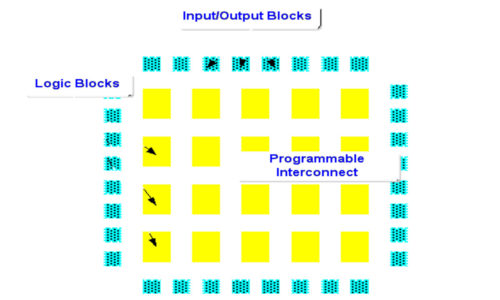
- Programmable logic blocks: arrays of look-up tables (LUTs) and flip-flops that implement the logic.
- Programmable routing: wiring channels and switch boxes that connect logic blocks to each other.
- I/O blocks: configurable pins that connect the FPGA to the outside world. Clock signals use dedicated low-skew networks.
- Hard blocks: modern FPGAs also include block RAM, DSP slices, high-speed transceivers and memory controllers.
FPGA design flow
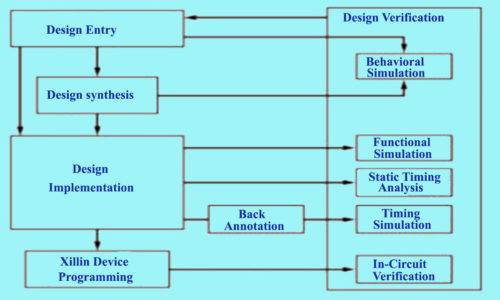
The flow runs from design entry (VHDL, Verilog or high-level synthesis from C/C++), through synthesis and implementation (place and route), to device programming. Verification runs alongside every step: behavioural simulation, functional simulation, static timing analysis and in-circuit verification on the board.
What has changed since 2018
- Vendors: Xilinx is now part of AMD, and Actel's FPGAs are now Microchip products. Altera and Lattice remain major suppliers.
- SoC FPGAs: many devices now combine FPGA fabric with ARM or RISC-V processor cores on one chip (for example AMD Zynq and Microchip PolarFire SoC).
- New uses: edge AI, software-defined radio, high-speed data acquisition and industrial networking.
- Higher-level tools: high-level synthesis and ready-made IP cores shorten development time.
Argus Technologies supplies FPGA development boards and offers FPGA design and FPGA card assembly services. Contact us for specifications and quotes.
